The MSC secretome
The "secretome" is the collective term for everything a cell releases into its environment: soluble proteins, lipids, nucleic acids, and membrane-bound vesicles. For MSCs, the secretome is increasingly studied in its own right because much of the paracrine activity attributed to MSCs is reproduced by their conditioned medium and isolated vesicles.
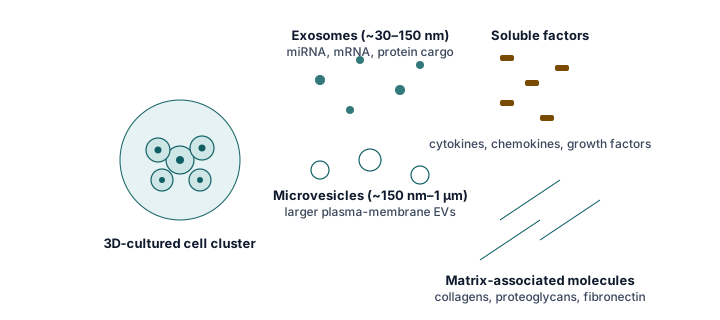
Three broad component classes
Soluble factors
Cytokines, chemokines, and growth factors are small to mid-sized proteins released into the medium. The MSC soluble fraction is reported to contain immunomodulatory factors (for example TSG-6, IDO, PGE2-related signalling), pro-angiogenic factors (VEGF, HGF, FGF family members), and matrix-related signalling proteins. Concentrations vary widely with donor, passage, oxygen level, and culture format.
Extracellular vesicles
Membrane-enclosed particles that fall into overlapping size and biogenesis classes — small vesicles released from multivesicular bodies (often called exosomes, ~30–150 nm), larger vesicles budding from the plasma membrane (microvesicles, ~150 nm to 1 µm), and apoptotic bodies. The current best practice for terminology and reporting is the MISEV guidance from the International Society for Extracellular Vesicles (see research).
Matrix-associated molecules
Collagens, proteoglycans, fibronectin, laminins, and matrix-modifying enzymes (MMPs and their inhibitors). In 2D plastic culture, much of this material is lost to the rinse step or never deposited at all; in 3D culture, cells build up a richer pericellular and intercellular matrix that itself becomes part of the secretome when matrix turnover releases fragments.
Why 3D culture shifts the secretome profile
The secretome is not a fixed shopping list. It reflects what cells "decide" to release based on the cues they receive — and those cues come from the matrix they sit on, the cells they touch, the oxygen they see, and the mechanical forces acting on them.
- Cell-cell contact activates contact-dependent signalling pathways (for example Notch and cadherin signalling) that are minimally engaged in sparse monolayer culture.
- Hypoxic niches in the centre of a spheroid stabilise HIF-1α and other oxygen-sensitive transcription factors, shifting expression of angiogenic and anti-apoptotic genes.
- Mechanical cues from a soft 3D matrix differ from those of stiff plastic; this changes cytoskeletal tension, which in turn changes nuclear shape and transcription factor localisation (e.g. YAP/TAZ).
- Endogenous ECM deposited by the cells themselves binds and presents many secreted factors, modulating their activity and their release kinetics.
The combined effect across many published reports is that 3D-cultured MSCs tend to express higher levels of certain immunomodulatory and anti-inflammatory factors than the same cells in 2D, and to release vesicles with a measurably different cargo profile.
Conditioned medium vs. isolated EVs
Two terms that often get confused:
- Conditioned medium — the entire culture supernatant, containing soluble factors, vesicles, matrix fragments, and any residual culture additives.
- Isolated extracellular vesicles — vesicles purified from that medium by ultracentrifugation, tangential flow filtration, size-exclusion chromatography, or affinity capture, with the soluble fraction substantially removed.
Studies that report on the "MSC secretome" may mean either, and the distinction matters for interpreting findings. Whenever possible, look for papers that specify the isolation method and characterise the resulting preparation by particle count, size distribution, and marker expression.