3D vs 2D culture of mesenchymal stem cells
Two-dimensional culture is the historical default for MSC work because it is cheap, easy to image, and well characterised. Three-dimensional culture is harder to standardise but recreates more of the cellular context that exists in living tissue. Both formats remain in active use; they answer different questions.
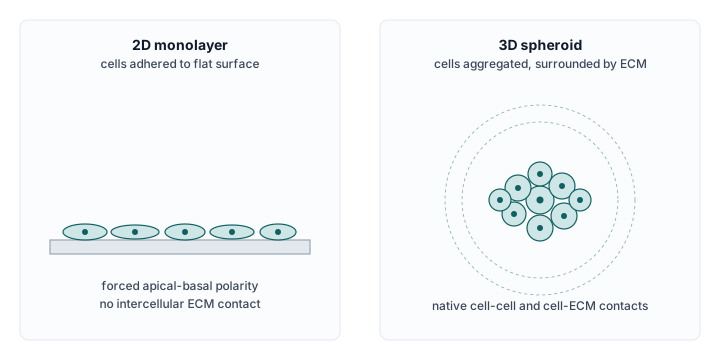
The basic difference
In 2D culture, MSCs adhere to a flat tissue-culture plastic surface. They flatten out, develop a forced apical-basal polarity (one face down on plastic, one face up to the medium), and form contacts with neighbouring cells primarily along their edges. Nutrient and oxygen exchange is uniform across the monolayer.
In 3D culture, cells either aggregate into spheroids, occupy a porous scaffold, or grow in suspension in a bioreactor. They form contacts in all directions, deposit their own extracellular matrix, and experience gradients of oxygen, nutrients, and waste products that more closely resemble tissue. Cells in the centre of a large spheroid see different conditions to those at the surface.
What changes when MSCs move from 2D to 3D
| Feature | 2D monolayer | 3D culture |
|---|---|---|
| Cell shape | Spread, flattened | Rounded, native morphology |
| Polarity | Forced apical-basal | Three-dimensional, tissue-like |
| Cell-cell contacts | Lateral only | All directions |
| Cell-ECM contacts | Substrate (plastic) below | Endogenous ECM all around |
| Oxygen / nutrient profile | Uniform across monolayer | Gradient — surface vs core |
| Stemness markers | Decline with passage | Better retained in many reports |
| Paracrine output | Baseline cytokine profile | Shifted profile; often higher anti-inflammatory factor expression |
| EV yield per cell | Reference baseline | Reported higher in many bioreactor and spheroid systems |
For citations supporting each row see the research page.
Common 3D formats
Spheroids and aggregates
Cells are forced or allowed to aggregate — for example in low-attachment plates, hanging drops, or stirred suspension — and form rounded multicellular clusters of a few hundred to a few thousand cells. Spheroid culture is the most-cited 3D format in the MSC literature because it is the simplest format that reliably changes cell phenotype.
Scaffold culture
Cells are seeded on or in a porous biomaterial — for example a collagen sponge, a synthetic polymer scaffold, or a decellularised tissue matrix. The scaffold provides mechanical support and a surface chemistry that can be tuned to mimic specific tissues.
Hydrogels
Cells are suspended in a soft, water-rich polymer network (alginate, hyaluronic acid, fibrin, or synthetic equivalents). Hydrogels allow precise tuning of mechanical stiffness and degradation rate, both of which influence MSC behaviour.
Bioreactors
Hollow-fiber, stirred-tank, or microcarrier-based bioreactors support 3D culture at scale. Hollow-fiber systems in particular have been studied as a way to produce larger volumes of MSC-conditioned medium and EVs under controlled conditions.
What 3D culture does not change
Three-dimensional culture is not a magic switch. The donor source, passage number, base medium, oxygen tension, and downstream isolation method all continue to matter, often more than the dimensional format alone. Reports comparing 3D and 2D from the same donor and with matched media are the most informative.